


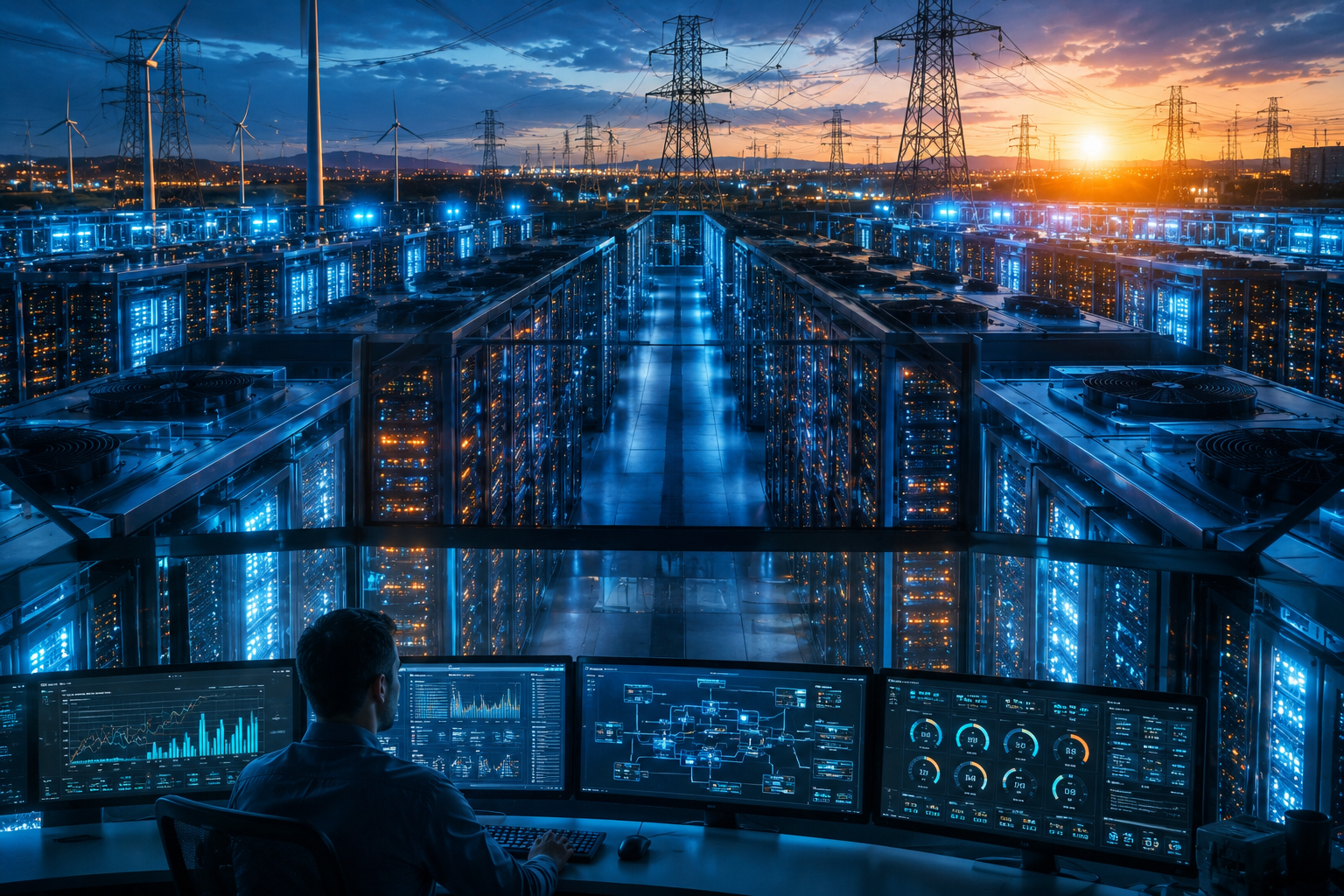
AI Electricity Demand is rapidly emerging as one of the most important issues facing the technology industry. For years, discussions about artificial intelligence focused on advanced semiconductors, critical minerals, and supply chain constraints. However, a new concern is now taking center stage: electricity.
The global AI race is accelerating at an incredible pace. Technology giants are investing billions of dollars into data centers, advanced computing infrastructure, and next-generation AI models. Every new chatbot, image generator, coding assistant, and AI-powered search engine requires enormous computing power. That computing power, in turn, requires massive amounts of electricity.
While many experts once believed that shortages of lithium, copper, rare earth elements, and other critical materials would slow AI development, a growing number of analysts now argue that the real bottleneck could be energy production. Without enough electricity, even the world’s most advanced AI chips cannot operate effectively.
As artificial intelligence becomes more deeply integrated into everyday life, the challenge of supplying sufficient power is becoming impossible to ignore.
Why AI Electricity Demand Is Growing So Fast: AI Electricity Demand
Artificial intelligence is unlike most traditional software applications.
Conventional programs perform relatively simple tasks and consume moderate computing resources. Modern AI systems, however, rely on billions or even trillions of calculations to generate responses, analyze information, and learn from vast datasets.
Every AI request requires servers to process huge amounts of data within seconds. When millions of users interact with AI systems simultaneously, electricity consumption rises dramatically.
The problem becomes even larger when companies train new AI models.
Training advanced systems can take weeks or months of continuous computing activity across thousands of specialized processors. This process consumes far more electricity than many people realize.
The Rise of Generative AI
The explosive popularity of generative AI has accelerated energy demand significantly.
Applications that create text, images, videos, code, and audio require extensive computing resources. As more businesses integrate AI into their operations, the demand for processing power continues to climb.
What began as a niche technology has quickly become a major consumer of electricity across the global economy.
More Users Mean More Power Consumption: AI Electricity Demand
Artificial intelligence is no longer limited to research labs.
Today, AI tools are used by:
- Businesses
- Students
- Software developers
- Marketing teams
- Healthcare providers
- Financial institutions
Each new user adds pressure to the infrastructure supporting these services. As adoption expands worldwide, electricity demand rises alongside it.
The Data Center Boom Is Transforming Energy Markets: AI Electricity Demand
At the heart of the AI revolution lies the modern data center.
These facilities contain thousands of servers working around the clock to process information and deliver AI services. Without data centers, today’s AI systems simply would not exist.
To meet growing demand, technology companies are building data centers at an unprecedented rate.
Why Data Centers Require So Much Energy
A modern AI data center does far more than store information.
It powers:
- AI model training
- Real-time AI interactions
- Cloud computing services
- Data storage
- Advanced analytics
In addition to powering servers, data centers require extensive cooling systems to prevent equipment from overheating.
This means electricity is needed not only for computing but also for maintaining safe operating temperatures.
The Competition for Power
As more facilities are built, competition for electricity is increasing.
Some regions are already experiencing challenges in providing enough power to support both existing communities and new data center projects.
In many cases, obtaining a reliable power supply has become one of the most important factors when selecting locations for future AI infrastructure.
Why Electricity May Matter More Than Critical Metals: AI Electricity Demand
For years, concerns about artificial intelligence focused heavily on critical minerals.
Copper, lithium, nickel, cobalt, and rare earth elements are essential components in modern technology. Many experts believed shortages of these materials would slow AI growth.
However, electricity presents a different type of challenge.
Materials Can Be Mined
Although mining projects often take years to develop, additional supplies of critical minerals can eventually be brought online.
New deposits can be discovered, investments can increase production, and alternative sources can be developed.
Electricity is different.
Power must be generated and delivered exactly when it is needed.
A shortage cannot simply be stored away and used later on a massive scale.
Energy Infrastructure Takes Time: AI Electricity Demand
Building new power plants, transmission lines, and grid infrastructure requires significant investment and planning.
Many projects take years or even decades to complete.
As AI demand grows rapidly, energy infrastructure may struggle to keep pace.
This mismatch is why many experts believe electricity could become the industry’s most significant long-term challenge.
Can Power Grids Keep Up With AI Growth?
The answer remains uncertain.
Many power grids were designed long before the rise of artificial intelligence. They were built to support homes, businesses, and traditional industries—not thousands of energy-intensive AI servers operating continuously.
Growing Pressure on Utilities
Electric utility companies are now facing increasing pressure.
They must find ways to:
- Expand generation capacity
- Improve transmission systems
- Modernize aging infrastructure
- Support growing industrial demand
At the same time, they must maintain reliable service for existing customers.
Balancing these priorities is becoming increasingly difficult.
Regional Constraints Are Emerging: AI Electricity Demand
Some areas already face limitations in available electricity capacity.
In certain regions, proposed data center projects have encountered delays because local grids cannot immediately support additional demand.
As AI investments continue expanding, these challenges could become more common.
How Technology Companies Are Responding: AI Electricity Demand
Major technology firms understand that energy availability is becoming a strategic priority.
As a result, many companies are taking direct action to secure long-term electricity supplies.
Investing in Renewable Energy
Renewable energy projects are becoming increasingly important.
Technology companies are funding:
- Solar farms
- Wind projects
- Battery storage systems
- Clean energy initiatives
These investments help support sustainability goals while providing additional electricity for future operations.
Exploring Nuclear Energy
Nuclear power is also receiving renewed attention.
Unlike solar and wind generation, nuclear facilities provide stable electricity around the clock.
For AI data centers that operate continuously, this reliability is extremely attractive.
Several major technology companies have already announced partnerships and investments related to nuclear energy development.
Building Smarter Infrastructure: AI Electricity Demand
Companies are also working to improve efficiency.
Advanced cooling systems, optimized processors, and more efficient data center designs can help reduce electricity consumption without sacrificing performance.
Even small efficiency gains can save enormous amounts of power when applied across thousands of servers.
What This Means for Investors and Energy Companies
The AI boom is creating opportunities far beyond the technology sector.
Energy companies are increasingly finding themselves at the center of the artificial intelligence revolution.
Rising Demand Creates New Opportunities
As electricity demand grows, companies involved in power generation, transmission, and infrastructure development may benefit.
Investors are paying close attention to sectors such as:
- Utilities
- Nuclear energy
- Renewable energy
- Grid infrastructure
- Electrical equipment manufacturing
These industries could play a critical role in supporting future AI growth.
Energy Is Becoming a Competitive Advantage
In the past, access to advanced chips was often viewed as the key advantage in artificial intelligence.
Today, access to reliable electricity is becoming equally important.
Companies that secure long-term power supplies may gain a significant competitive edge over rivals struggling with energy constraints.
What the Future of AI Depends On
Artificial intelligence continues to evolve at an extraordinary pace.
New models are becoming more powerful, more capable, and more widely used every year. However, future progress will depend on more than software innovation.
The industry must also address the physical infrastructure supporting AI.
A Growing Need for Long-Term Planning
Governments, utility providers, and technology companies will need to work together.
Future priorities may include:
- Expanding generation capacity
- Modernizing power grids
- Supporting clean energy development
- Improving energy efficiency
- Encouraging infrastructure investment
Without these efforts, electricity shortages could eventually limit AI expansion.
The Next Phase of the AI Revolution
The first phase of artificial intelligence focused on creating powerful models.
The next phase may focus on powering them.
As demand continues to rise, electricity could become one of the most valuable resources in the AI economy.
Final Thoughts
AI Electricity Demand is quickly becoming one of the defining challenges of the artificial intelligence era. While concerns about critical minerals and semiconductor shortages remain important, the growing need for reliable electricity is now attracting even greater attention.
The rapid expansion of AI data centers, cloud infrastructure, and advanced computing systems is placing unprecedented pressure on power grids around the world. Technology companies are responding through investments in renewable energy, nuclear power, and more efficient infrastructure, but significant challenges remain.
As artificial intelligence continues transforming industries and everyday life, one reality is becoming increasingly clear: the future of AI will depend not only on smarter algorithms and faster chips but also on the ability to generate and deliver enough electricity to power them.
Read Other Interesting news here: GTA 6 Preorders
